HISTORICAL RECORDING CASE STUDY · ONE PERFORMANCE, MANY AFTERLIVES

A Beautiful
Error

Vienna, December 1944. Furtwängler and the Vienna Philharmonic record Beethoven's Eroica for the microphone. The performance then begins a second life: wartime magnetic tape, post-war copies, an unauthorized Urania LP, a court case, collectors' editions and later digital restorations. By the time modern listeners meet the recording, they are not all hearing quite the same historical object.

PERFORMANCEBeethoven · Symphony No. 3
CONDUCTORWilhelm Furtwängler
RECORDEDVienna · 19–20 Dec 1944
THREE EDITIONS STUDIEDGreen Door · Tahra · Melodiya
Urania Eroica cover
Urania image / Green Door lineage
Tahra FURT 2008 cover
Tahra FURT 2008
Melodiya MEL CD 10 01106 cover
Melodiya 2006

01 · HOW ONE PERFORMANCE BECAME MANY OBJECTS

The story starts before Urania—and the error may, too.

WHY THIS RECORDING? One famous performance survives through several physical copies. A speed error can belong to one of those copies rather than to the performance itself.

01 · VIENNA · 19–20 DECEMBER 1944

First came the performance—and a magnetic tape.

Tahra describes this as a Magnetofonkonzert in the Musikverein, recorded by Friedrich Schnapp. So the first surviving carrier in this story is magnetic tape, not an LP.

The performance itself already has Furtwängler's unmistakable rubato. The first movement lasts about fifteen minutes, but the pulse is never mechanical: broad rubato, sudden accelerations and carefully shaped slow-downs are part of the interpretation. Harry Halbreich describes the result as both tightly built and powerfully driven.

A later copy can change the overall speed of the recording. It cannot create all of those local changes of tempo. Those belong to the performance.

02 · 1953 · URANIA URLP 7095

Then the tape became a commercial LP.

In 1953 the American label Urania released the 1944 Eroica as URLP 7095. Tahra's booklet says that this release was made without Furtwängler's authorization.

This is the first big change in the chain: a concert recorded on tape had now become a record that people could buy, play on different equipment and copy again. The Urania disc therefore carried not only the performance, but also the sound of that particular transfer and playback history.

03 · 1957 · THE COURT CASE

Permission to record was not permission to press records.

Furtwängler had agreed to the making of magnetic recordings of his performances. The dispute was whether that permission also allowed someone else to manufacture and sell records from those tapes.

The French case ended in Furtwängler's favour in 1957. In simple terms, the court accepted that permission for one use of a performance did not automatically give permission for another. That is why the Urania LP matters here as more than a collector's curiosity: it is a separate object with its own legal and technical history.

04 · LATER COPIES · THE PITCH PROBLEM

The famous “E-major Eroica” was not necessarily born on the LP.

By 1970 the Urania / Turnabout version was already known for playing about a semitone too high. Our Green Door transfer, which follows that Urania-family branch, measures about +97 cents relative to Tahra's corrected first movement.

But Tahra adds an important complication: the DRA tape copy used for its own edition was also at the wrong pitch, with a total timing of 50:27, before Tahra corrected it. So the speed problem may have entered the chain before the Urania LP was cut.

What we still do not know: exactly where the wrong speed first appeared. The documents, collector reports and the signals let us narrow the story, but not place the error at one single step with certainty.

02 · THE RECORD SHELF

Three editions. Three different claims on the past.

Each edition is useful for a different reason. Green Door preserves the famous Urania-family wrong-speed state; Tahra explicitly intervenes to correct pitch; Melodiya gives us a third transfer tradition whose exact mastering chain is less fully documented.

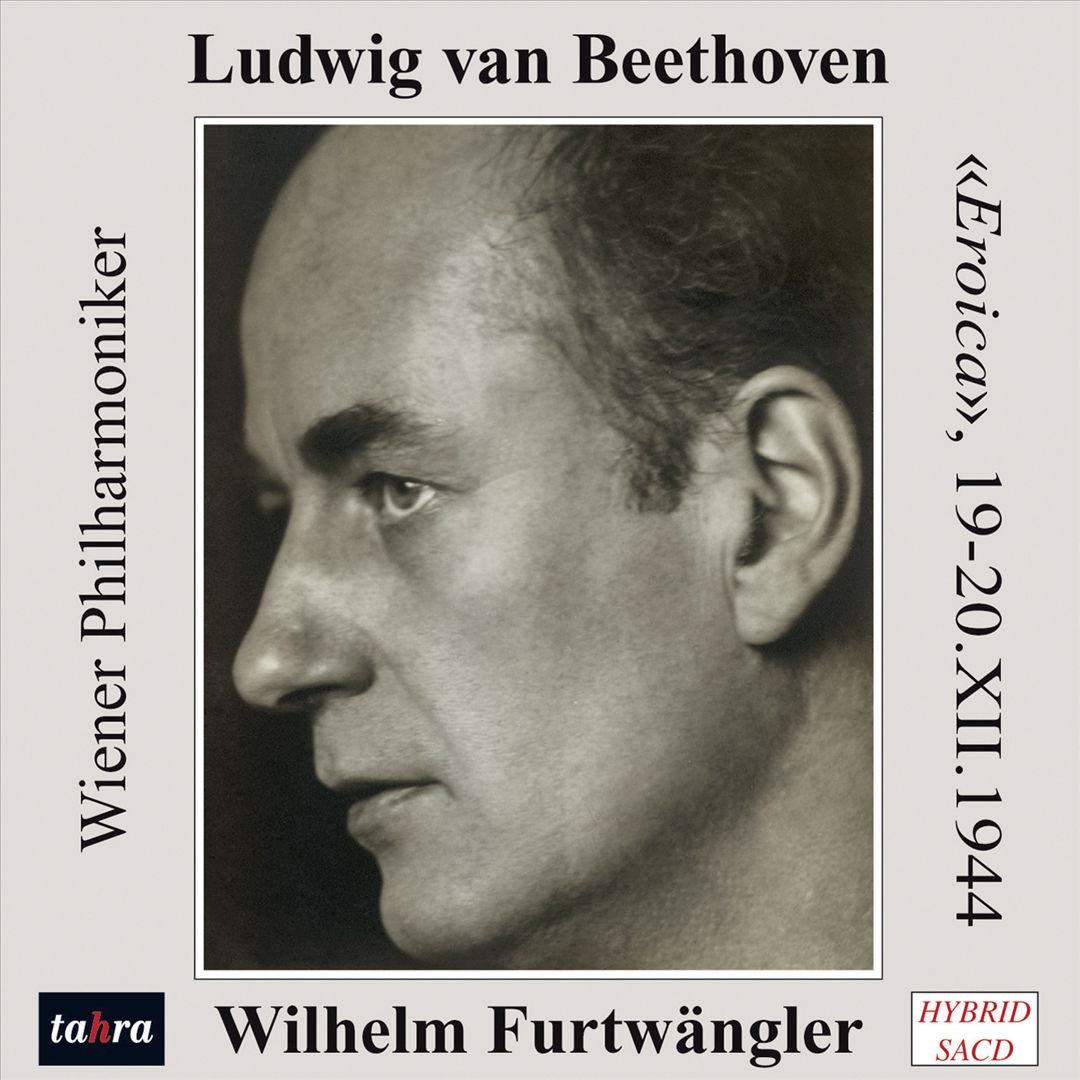
Urania Eroica cover used to represent Green Door's Urania lineage
01 · GREEN DOOR

GDCL-0001

The Urania-family object with pitch left uncorrected.

Uploaded source
APE · 44.1 kHz · 16-bit
Eroica span
50:26.893
Collector source claim
URLP 7095 first stamper E3KP-4554-1A / 4555-1
Pitch treatment
uncorrected
Our first-movement result
≈ +97¢ vs Tahra

The Japanese discography identifies GDCL-0001 as a transfer from the first-stamper Urania LP and explicitly says that pitch was not corrected. It also reports heavy surface crackle and suggests a stereo cartridge was used. Our uploaded file is consistent with a non-dual-mono transfer: its side-channel level is around −20 dB relative to mid, although that measurement alone cannot identify the cartridge or mastering chain.

Tahra FURT 2008 cover
02 · TAHRA

FURT 2008

The edition that states exactly what it corrected.

Uploaded source
FLAC · 44.1 kHz · 16-bit
File span
53:07.573
Source claim
copy of DRA original tapes
Pitch treatment
explicitly corrected
Remastering
C. Eddi

Tahra had already issued the archive as FURT 1031 in 1998 and revisited it for FURT 2008. The supplied booklet is unusually useful: it says the DRA tape copy itself had wrong pitch and a 50:27 timing, then states that Tahra corrected it. That sentence is central to this project because it makes the pitch problem a tape-provenance question, not merely an LP anecdote.

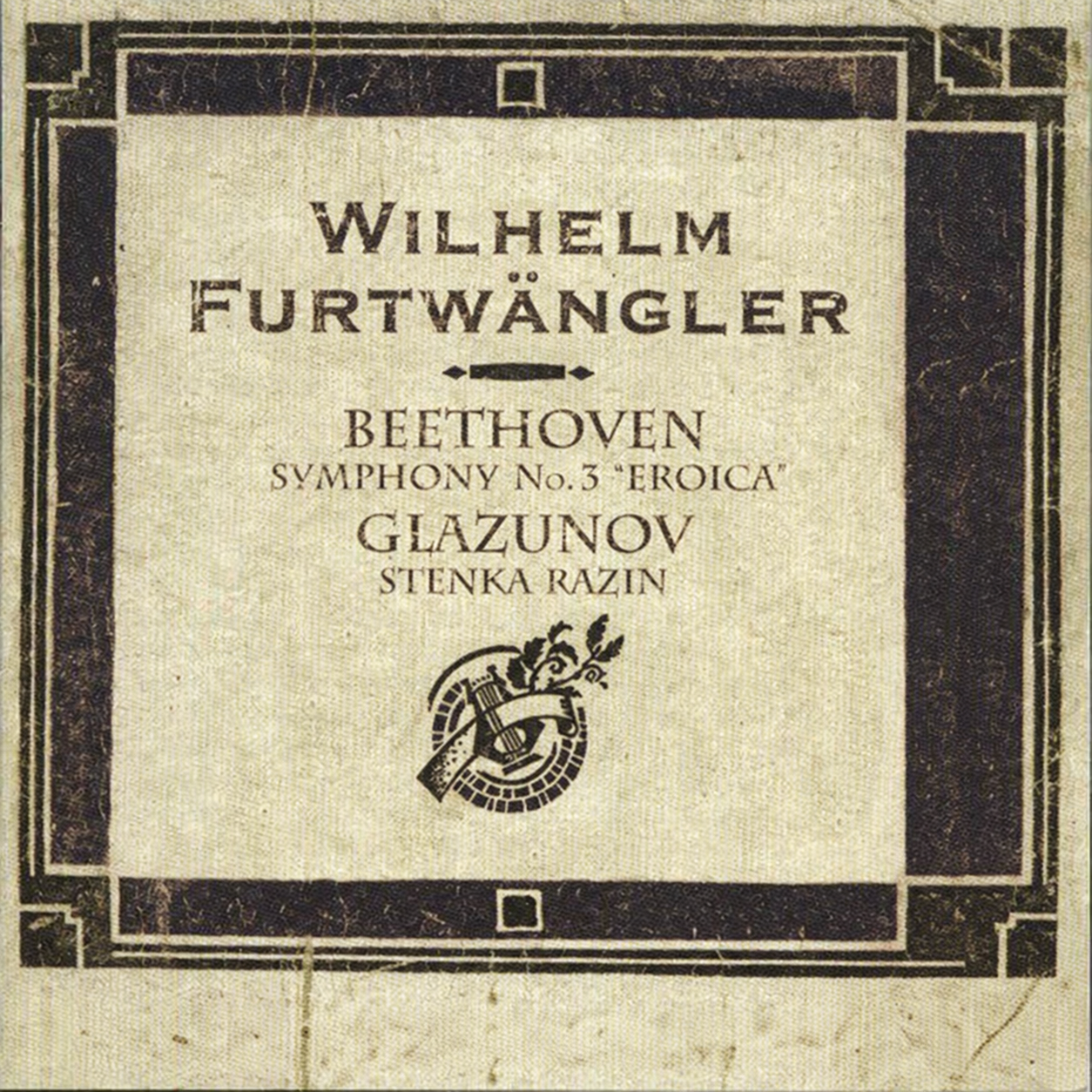
Melodiya Furtwangler Eroica and Stenka Razin cover
03 · MELODIYA

MEL CD 10 01106

A Soviet / Melodiya branch that refuses to sit neatly at either extreme.

Uploaded source
APE · 44.1 kHz · 16-bit
Eroica cue span
52:05.333
Release
Melodiya · 2006
Our first-movement result
≈ +21¢ vs Tahra
Channel structure
substantial L/R difference

Melodiya's official catalogue confirms the 2006 Eroica + Stenka Razin issue. Its exact tape generation is not documented for us as clearly as Tahra's. The Japanese comparison page reports that both the 1993 and 2006 editions credit T. Badeyan and share several defects, and therefore argues that they likely use the same master. We treat that as collector inference. Our own signal result is independent: this file runs only about +21 cents above Tahra in the first movement, much closer to the corrected reference than Green Door. The disc also couples the Eroica with Glazunov's Stenka Razin; modern reviews dispute the attribution of that Glazunov performance to Furtwängler, a separate provenance issue that does not affect the Eroica comparison here.

IMPORTANT EDITIONS NOT YET IN THE AUDIO CORPUS
Altus ALT154

LP-transfer / laser-playback route; useful future comparison with Urania-derived editions.

Delta / Grand Slam

Particularly valuable where corrected and uncorrected material from the same LP-transfer project can be compared.

WFSC-005

A recent restoration endpoint claiming multi-master comparison and detailed pitch work.

03 · LISTEN BEFORE READING THE GRAPHS

Five passages across the whole symphony.

For me, Beethoven's Eroica is the summit of the Classical symphony. Mahler's Ninth, growing from a single note into an entire world, is the summit of the Romantic symphony: a singular act of the spirit, and a work that can move me to tears at any stage of life. These five excerpts range from the first two chords of the Eroica to its final coda, while also letting us hear what the different transfers change.

PASSAGE
COMPARISON MODE

Original transfer speed and pitch are retained. The three clips are level-matched, but their durations differ because the editions do not always run at exactly the same speed.

PASSAGE 01 · GREEN DOOR I · 00:01–00:11

Opening attack

historical transfer
0:00 / 0:10
EDITIONGreen Door GDCL-0001
PROCESSING FOR THIS PLAYERRMS level matched; historical speed / pitch retained
GREEN DOOR BASELINEI · 00:01–00:11
WHAT TO LISTEN FOR · OPENINGPitch first; then attack.

The first two E-flat chords are almost a laboratory test. In historical-transfer mode, Green Door sounds higher and passes more quickly. In matched mode, listen instead to the hard edge of the chords, string brightness and surface noise.

WHAT TO LISTEN FOR · E-MINOR REFLECTIONA ghost inside the battle.

After an intense stretch of battle and struggle, a new E-minor idea appears for only a moment: a melancholy, inward glimpse inside the hero's mind. It vanishes almost as soon as it arrives, then returns again and again like a ghost within the continuing battle. This is the curator's favourite moment: less public triumph than private reflection. Compare how the same phrase changes weight and colour when the transfer speed changes.

WHAT TO LISTEN FOR · MARCIA FUNEBRE FUGUEA funeral march becomes a huge piece of counterpoint.

This excerpt is deliberately much longer. One line enters after another, the texture thickens, and Furtwängler turns the fugue into an enormous cumulative wave. Here the point is not one isolated sound but whether each transfer lets the architecture remain clear while the pressure keeps rising.

WHAT TO LISTEN FOR · HORN TRIOThree horns suddenly open the space.

In the Scherzo trio, the horn calls are bright, exposed and easy to recognise. Compare their colour, the space around them and the way each transfer separates the three instruments from the orchestra behind them.

WHAT TO LISTEN FOR · FINALE CODAThe whole symphony breaks into a final sprint.

The last forty-nine seconds of the Green Door performance capture Furtwängler's sudden coda acceleration: tension is released as forward motion. Compare how much of that violence comes from the performance itself, and how much its physical impact changes when transfer speed and pitch are brought onto the same time scale.

How the application-review excerpts were prepared

The Green Door transfer is the selection baseline. Passage 01 uses the opening; Passage 02 keeps the E-minor reflection already used in the earlier version of this page. Passage 03 is the second-movement fugue from 07:25 to 10:21 in Green Door; Passage 04 is the Scherzo horn trio from 02:47 to 03:06; Passage 05 is the final forty-nine seconds of musical material in the finale coda. The corresponding Tahra and Melodiya passages were located from the same performance rather than by copying the same clock times.

Historical transfer preserves each edition's own speed and pitch. Pitch / time matched rescales Green Door and Melodiya to the duration of the corresponding Tahra passage. Each excerpt is level-matched across editions with a peak ceiling; no denoising, EQ or dynamic processing is added by this player.

Matching to Tahra is a comparison operation, not a claim that Tahra reproduces an absolute 1944 concert pitch perfectly. The ≈ +97¢ and ≈ +21¢ labels are first-movement measurements and should not be read as a promise that every later movement has exactly the same transfer-speed offset.

Audio excerpt acknowledgements

Performance: Ludwig van Beethoven, Symphony No. 3 in E-flat major, Op. 55; Wilhelm Furtwängler / Wiener Philharmoniker; Musikverein, Vienna; 19–20 December 1944.

Compared editions: Green Door GDCL-0001; Tahra FURT 2008; Melodiya MEL CD 10 01106. Tahra's booklet identifies its source as a copy of the original tapes held by the Deutsche Rundfunk Archiv and states that pitch correction was applied.

These excerpts are reproduced only within this limited academic review copy for comparative criticism, review and technical analysis. No complete movement or complete track is distributed here.

04 · PUTTING THE EDITIONS ON THE SAME CLOCK

Speed is the first difference, not the whole story.

With analogue tape or disc, faster playback makes every event shorter and every frequency higher. The editions need a common time scale before tone, noise or dynamics can be compared fairly.

TIMEFaster playback shortens the music.

A sixty-second passage becomes about 56.7 seconds when it runs 5.8% fast.

PITCHThe same speed change raises every note.

A 5.95% change equals 100 cents, or one equal-tempered semitone.

SPECTRUMNoise and overtones move as well.

The transfer can sound brighter before any equalisation has been added.

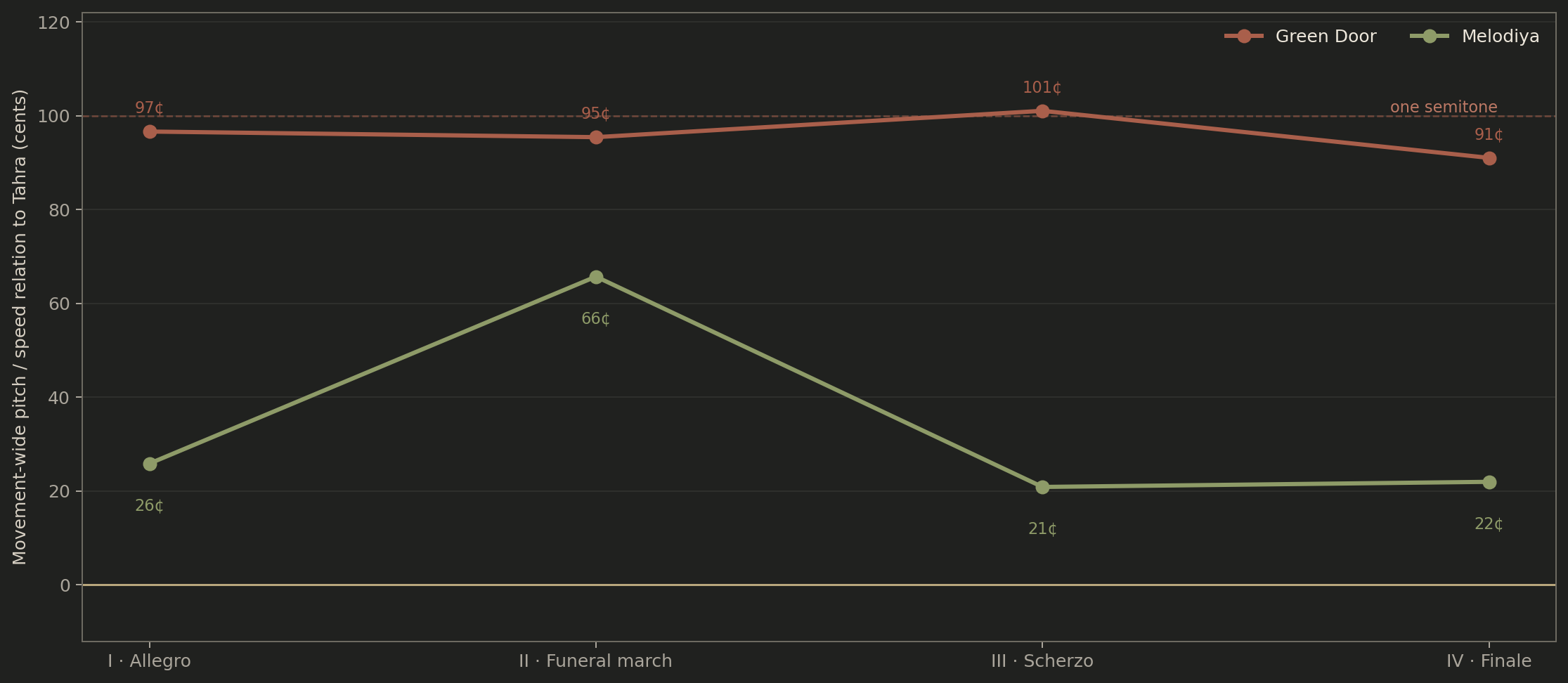
MOVEMENT-WIDE TIME-SCALE FITS · TAHRA = 0 CENTS The Green Door error is nearly stable. Melodiya changes between movements.

Each point comes from a separate fit to a complete movement. Inter-track gaps were excluded. Values are rounded because these are transfer comparisons, not absolute concert-pitch measurements.

Movement-wide transfer speed estimates for Green Door and Melodiya relative to Tahra
GREEN DOOR 91–101 cents above Tahra

All four movements remain close to the famous one-semitone description. The exact value drifts slightly, but the basic error is consistent.

MELODIYA The funeral march is the outlier.

Movements I, III and IV sit about 21–26 cents above Tahra. Movement II is about 66 cents above it. One global correction would not align the whole file.

WHAT THE SIGNAL CANNOT TELL US The reason for the change remains open.

A different tape copy, a splice or movement-level mastering could all create this pattern. The audio shows where the relation changes, not which historical step caused it.

Measurement details and the earlier +21-cent estimate

The first pass aligned a small set of clear first-movement attacks. It returned about +97 cents for Green Door and +21 cents for Melodiya relative to Tahra. The longer movement-wide fit returns +97 and +26 cents for the same movement.

The five-cent difference comes from using more of the movement, including sections with small local drift. It is a useful uncertainty check rather than a contradiction. The fitted map is tTahra = s tedition + b, with 1200 log₂(s) converting the time-scale factor to cents.

Tahra is a practical comparison reference because its booklet says that pitch was corrected. It is not treated as proof of the exact pitch heard in the Musikverein in 1944.

05 · THREE TRANSFER FINGERPRINTS

Once the clocks agree, other differences remain.

The same five passages were placed on the Tahra time scale and level-matched. That makes three other parts of the transfer easier to separate: tonal balance, low-level noise and left/right structure.

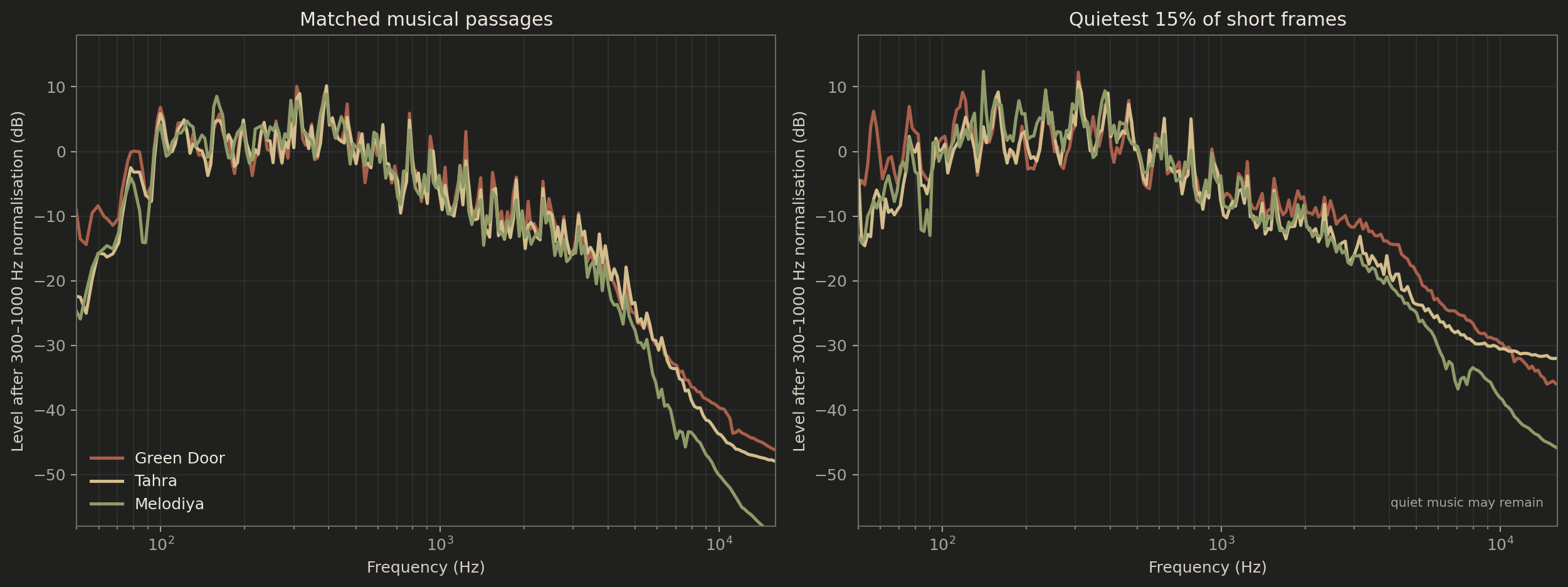
FREQUENCY PROFILE · FIVE MATCHED PASSAGES Musical balance on the left; the quietest short frames on the right.

Each passage has equal weight and each curve is normalised between 300 and 1000 Hz. The right panel is not a pure noise sample: quiet orchestral sound can remain.

Matched spectral profiles and low-level-frame profiles for the three transfers
BELOW ABOUT 3 kHzThe broad musical shapes are similar.

This is expected: the performance is the same, and the curves have already been matched in time and middle-band level.

ABOVE ABOUT 5 kHzMelodiya rolls off earlier.

Its upper-frequency energy falls faster than Tahra and Green Door across the five passages.

IN QUIET FRAMESGreen Door keeps the strongest high-frequency bed.

That extra energy may be hiss, crackle or transfer noise. It should not be renamed “detail” without further evidence.

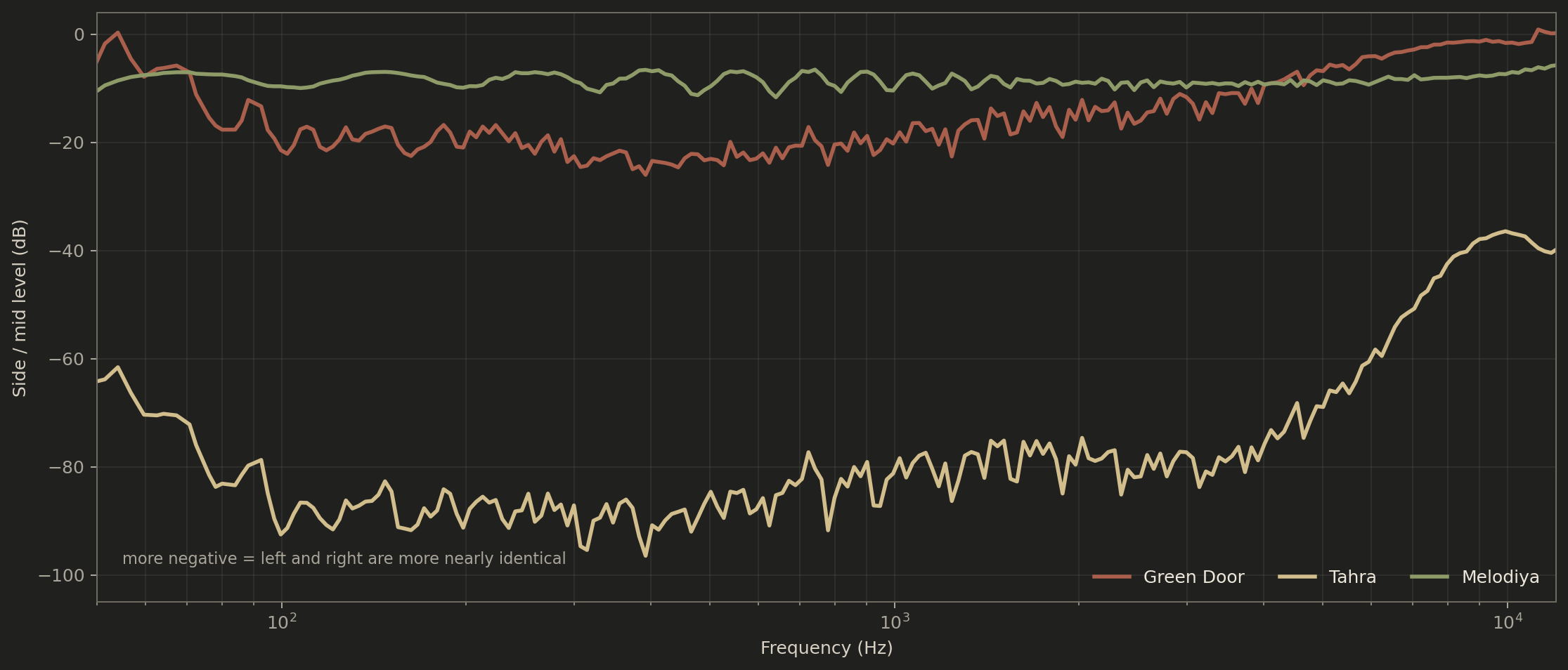
LEFT / RIGHT STRUCTURE BY FREQUENCY The 1944 performance is mono, but the digital files are not equivalent mono objects.

“Side” means the part that differs between left and right. A very negative value means that the two channels are almost identical.

Frequency-dependent side-to-mid level for Tahra, Green Door and Melodiya
GREEN DOORThe difference moves upward with frequency.

The side level is about −21 dB in the low middle band and −14 dB from 1–5 kHz, then rises sharply. Much of its left/right difference sits in the high-frequency region, where the quiet-frame plot also shows a stronger noise bed.

TAHRAThe channels are almost copies of each other.

Across 1–5 kHz, the side signal is about −78 dB below the common signal. In practical terms, this file is dual mono.

MELODIYAThe channel difference is wide-band.

Its side signal stays near −8 to −9 dB across much of the spectrum. This proves substantial channel structure, but not its cause and not “fake stereo” by itself.

06 · ONE PASSAGE UNDER THE MICROSCOPE

The E-minor turn lets each graph answer a different question.

The three versions below share the Tahra time scale and the same RMS level. The graphs move from the broad shape of the passage to one musical accent and one transfer defect.

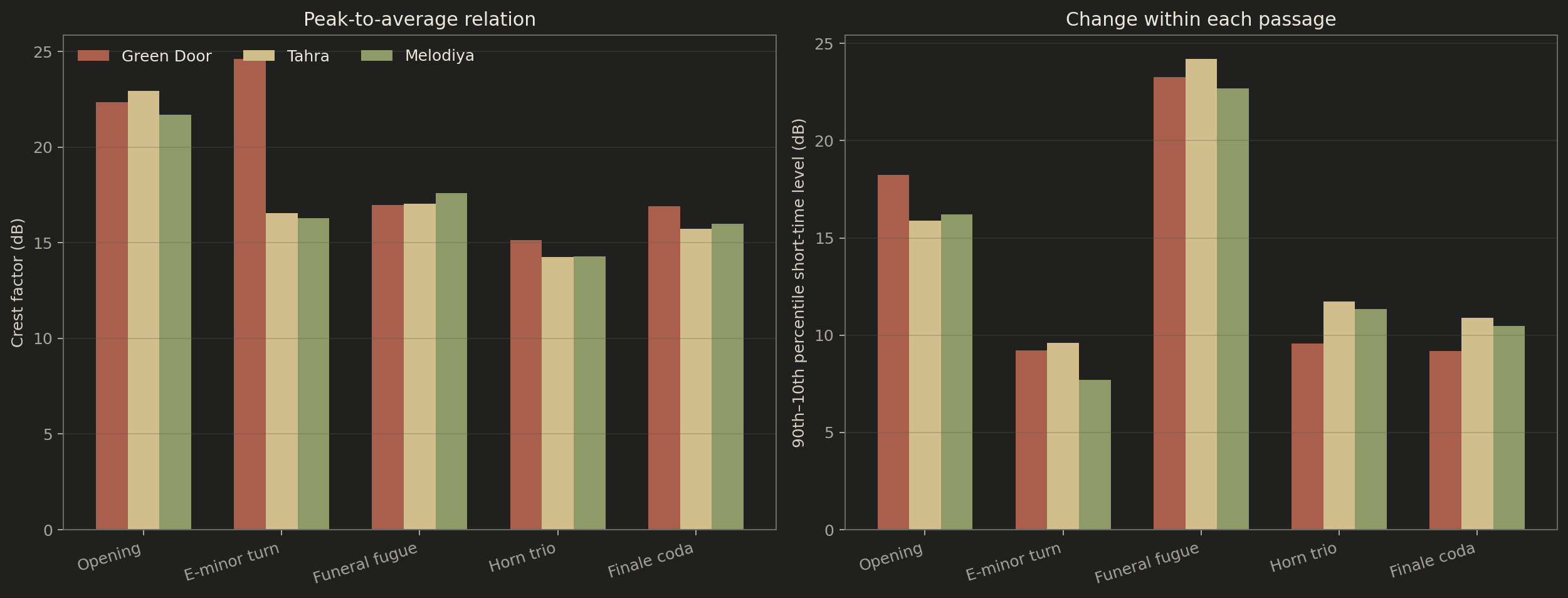
FIVE-PASSAGE CHECK Most broad dynamic measures stay close. One Green Door peak does not.

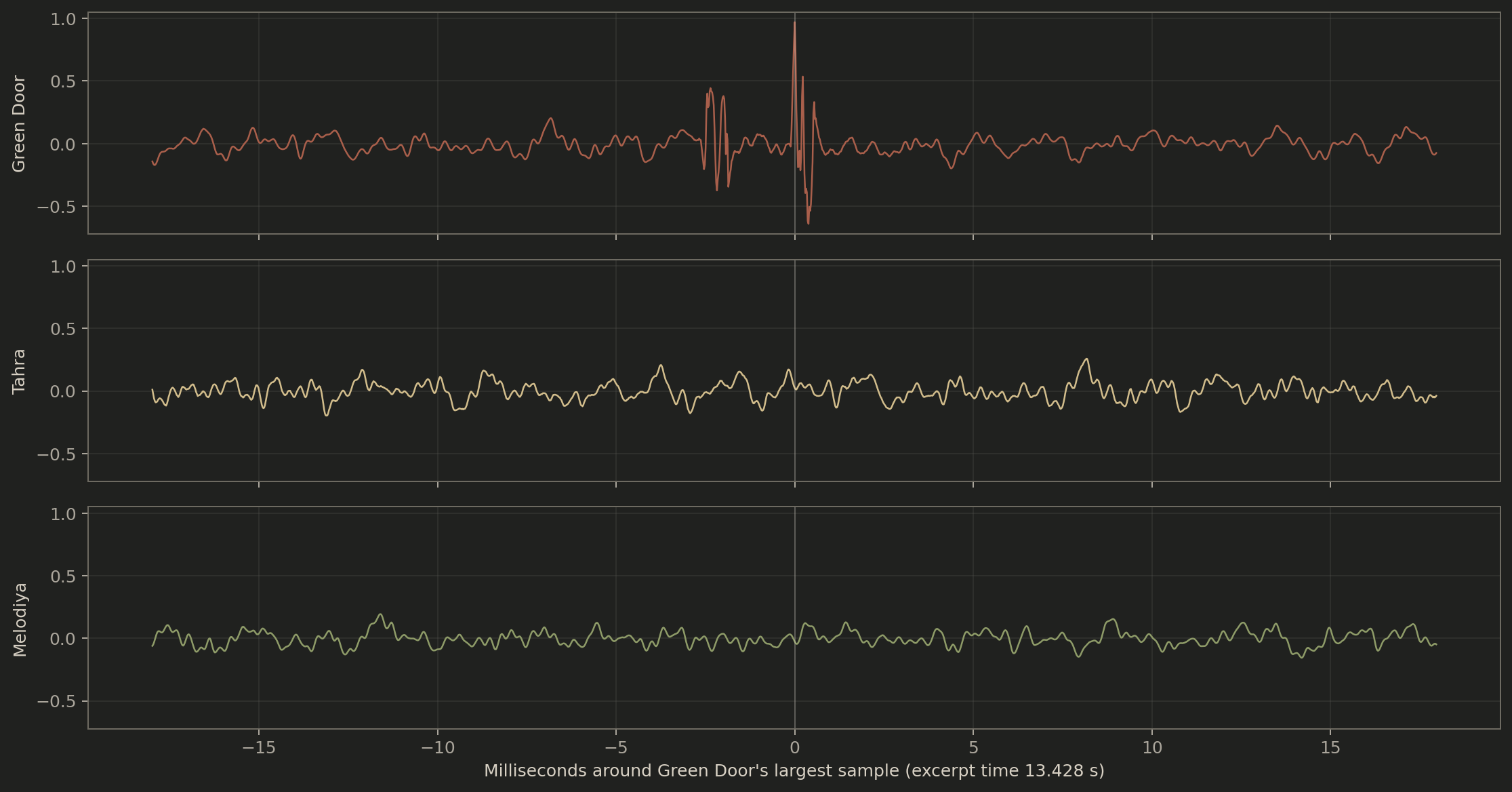
The E-minor excerpt gives Green Door a much larger peak-to-average value than the other two editions. The impulse zoom below shows why: the peak is a brief defect, not a larger orchestral climax.

Crest factor and short-term level range across the five matched passages
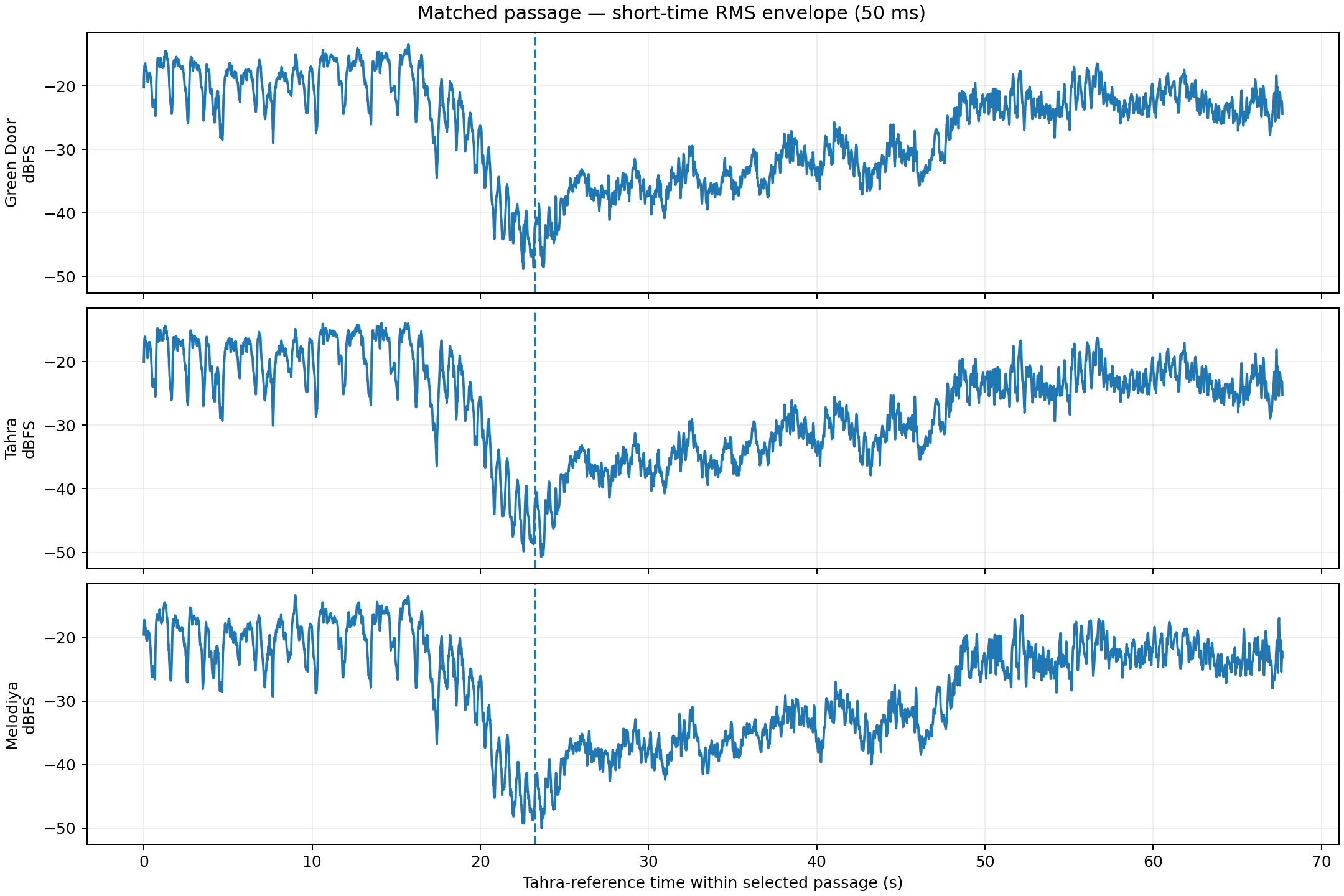
01 · AMPLITUDE ENVELOPEHow does the broad level change through the minute?

Short-time RMS shows the large-scale level shape. It helps align sections and compare broad dynamics, not tonal balance.

Matched short-time RMS envelopes for Green Door, Tahra and Melodiya
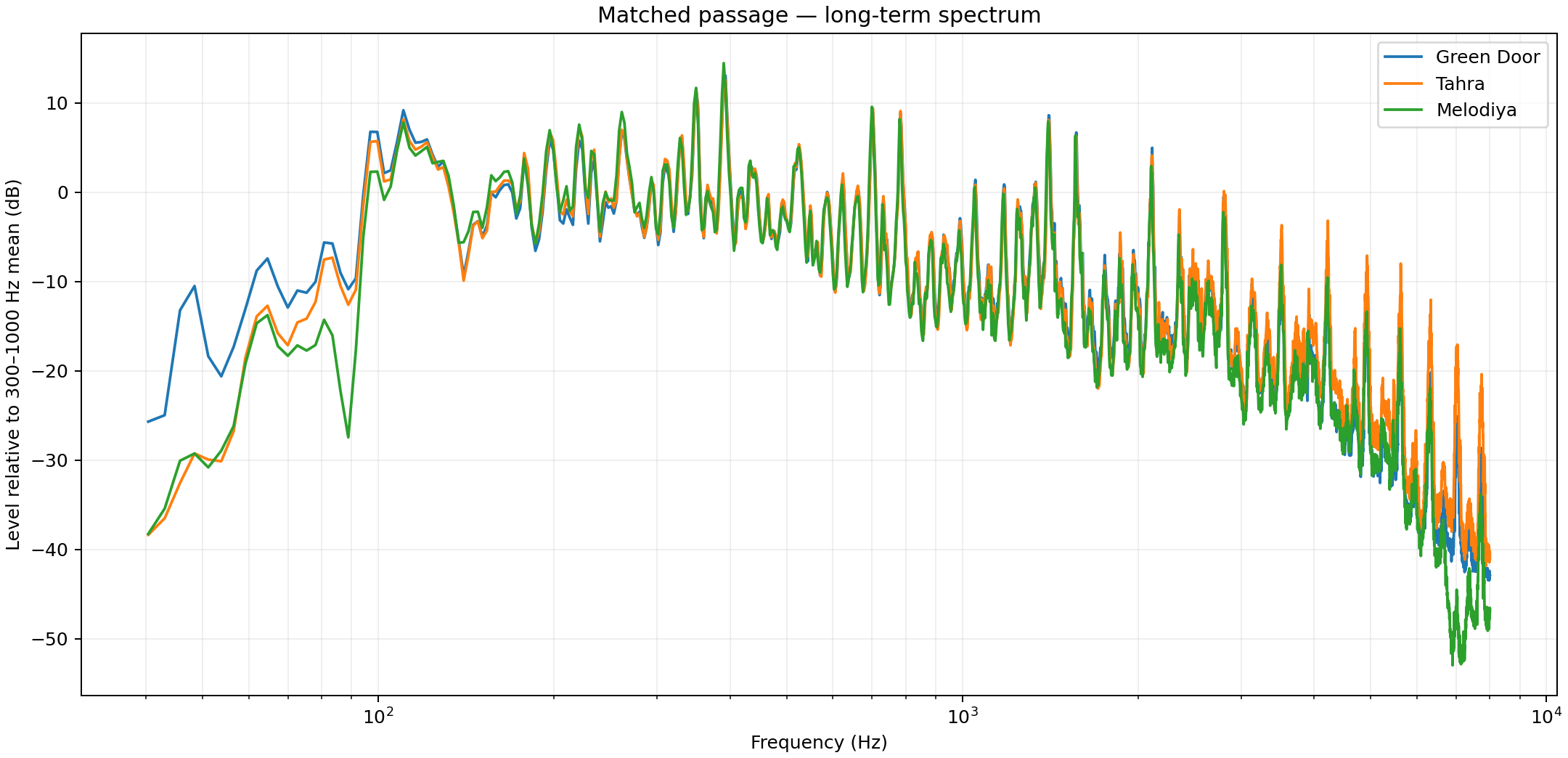
02 · SPECTRUM OF THIS MINUTEHow is its average energy divided by frequency?

This single passage makes Tahra's stronger 3–5 kHz region visible. It does not show when the difference occurs.

Long-term spectra for the matched E-minor passage
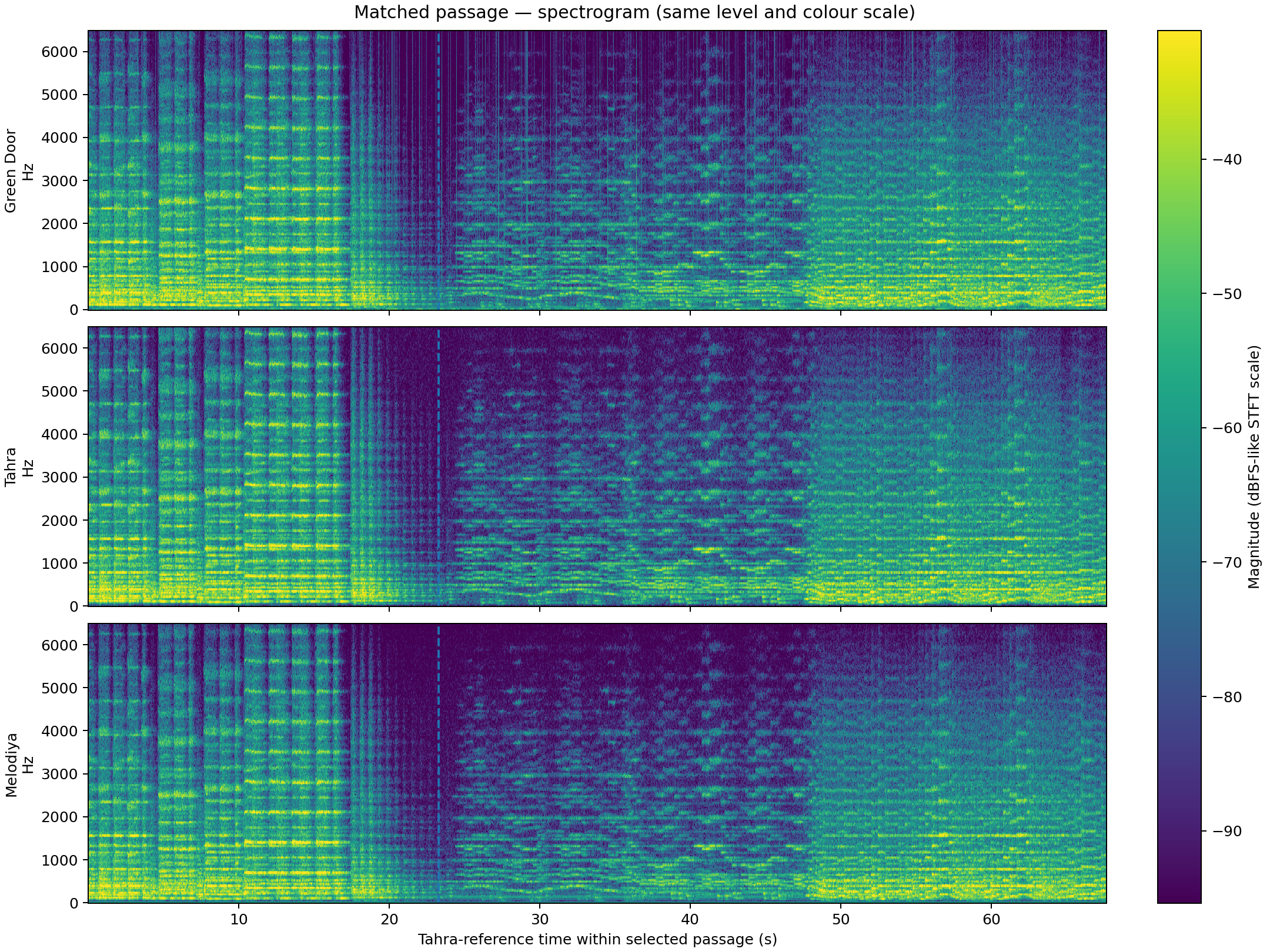
03 · SPECTROGRAMWhen does each frequency band appear?

Horizontal traces can reveal steady tones; thin vertical lines can reveal attacks or clicks; a broad haze can reveal noise. All panels use the same colour scale.

Three matched spectrograms of the development passage
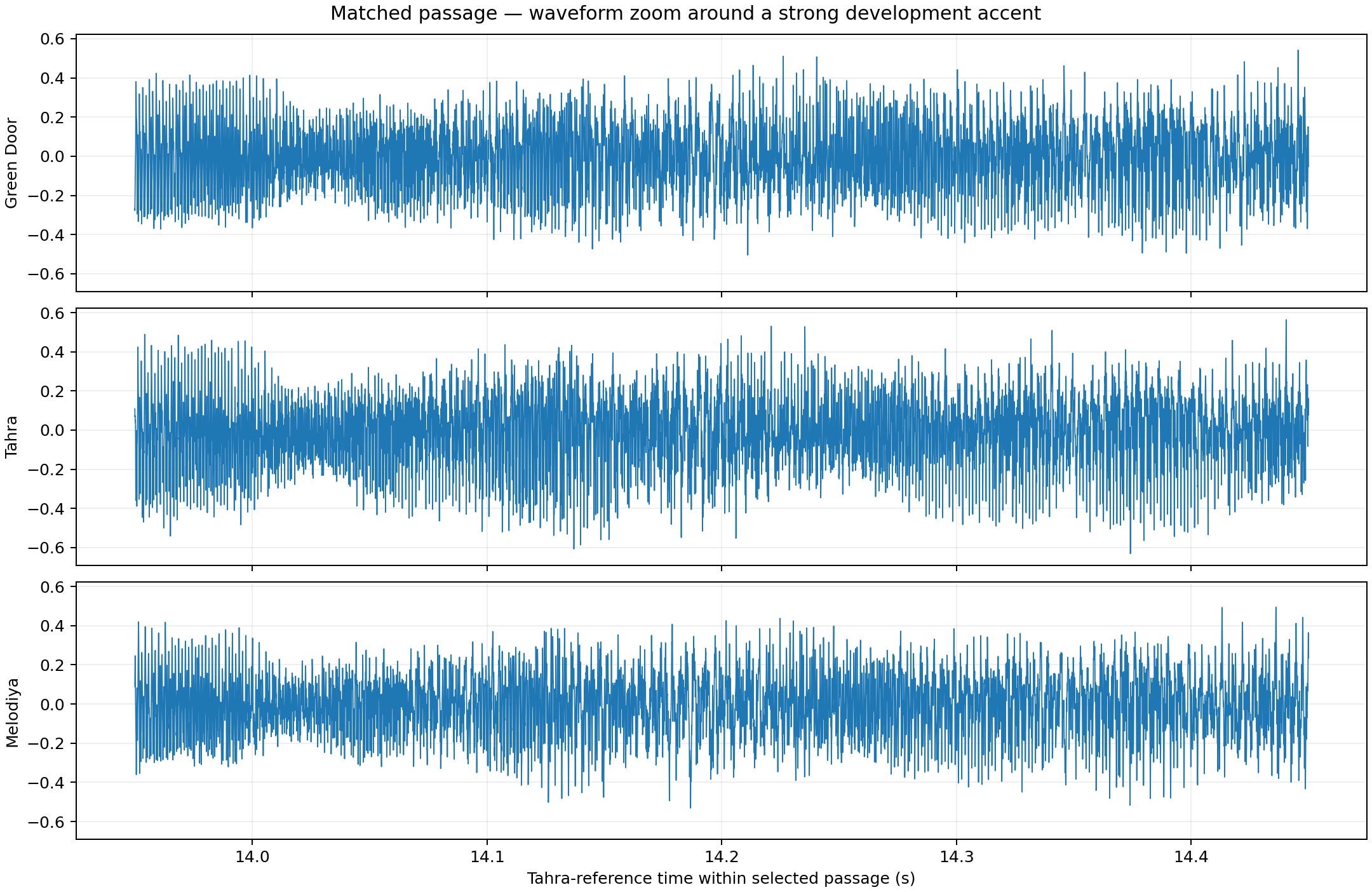
04 · MUSICAL TRANSIENTThe edge of one strong development accent.

This zoom compares the shape of the same orchestral event. Peak height alone is not a fidelity score.

Waveform zoom around a strong development accent for three transfers
05 · NON-MUSICAL IMPULSEGreen Door contains a sharp event that the other transfers do not share.

The spike lasts only a few milliseconds. It lifts the crest-factor result for this excerpt and is consistent with a click or transfer impulse, not extra musical dynamics.

Waveform zoom showing a sharp Green Door impulse absent from Tahra and Melodiya
What each view can and cannot show

Envelope: broad timing and dynamics. Spectrum: average frequency balance. Spectrogram: frequency through time. Waveform zoom: the shape of one event.

None of them proves fidelity alone. A bright spectrum can contain hiss. A high peak can be a click. A smooth spectrogram can reflect denoising. The matched audio above remains part of the evidence.

07 · WHAT RESTORATION ACTUALLY CHANGES

There is no single “restore” button.

A restoration is a chain of decisions. Each decision can solve one problem while changing another part of the document.

01 · SOURCEThe physical copy comes first.

A tape copy, LP pressing and later safety copy can carry different defects before digital work begins.

02 · CLOCKSpeed may change by movement.

The Melodiya result shows why one global number may be too simple.

03 · CHANNELSLeft and right need a documented choice.

Keeping, folding or rebalancing them changes noise and phase even when the music began as mono.

04 · REPAIRNarrow defects and broad noise are different jobs.

An isolated click can often be repaired. Broad denoising can also remove bow texture or room sound.

05 · PRESENTATIONA release master also shapes tone and level.

Equalisation can clarify the orchestra, but it cannot recreate information that never reached the source.

MINI LAB · 8-SECOND SYNTHETIC EXAMPLE

What does clean-up remove?

The four buttons use the same short signal. One is clean. One adds hum, hiss and clicks. One applies a mild clean-up. The last plays only what the clean-up removed.

This is not the historical recording.
NOWChoose one to listen.

*The residual is level-normalised so it can be heard. Its loudness should not be compared with the other three.

ARCHIVAL TRANSFERThe document remains intact.

The untouched digital capture, source notes and processing history remain available.

LISTENING MASTEREvery intervention is listed.

Speed correction, channel work, click repair, denoising and EQ are not presented as an invisible return to 1944.

08 · WHY THE ERROR IS BEAUTIFUL

The wrong speed became part of the recording's history.

Green Door's higher, shorter transfer does more than change note names. It tightens phrases, sharpens attacks and strengthens the nervous brilliance that many listeners associate with this performance.

The error is wrong as a guide to playback speed. It is real as a historical object: collectors heard it, critics described it and its sound helped shape the performance's legend.

A correction can bring us closer to the event while taking us farther from the version through which the event became famous.
PERFORMANCE

The musical event in Vienna in 1944, known only through surviving documents.

DOCUMENT

Each tape, copy, LP and digital transfer, with its own speed, noise and channel history.

LISTENING HISTORY

The versions that listeners actually knew, including errors that became familiar.

The careful answer is not to erase one version. It is to preserve the historical transfer, offer a clearly labelled correction and explain the difference.

09 · EVIDENCE / SOURCE MAP

Documents, reviews and signal measurements do different jobs.

Label documentation supports source and restoration claims. Reviews record reception. Collector research maps editions. The audio files support only claims that can be measured from their signals.

PRIMARY RELEASE DOCUMENT Tahra FURT 2008 booklet · supplied scan (PDF) ↗

Pages 10–11 identify Friedrich Schnapp, the 19–20 December 1944 Magnetofonkonzert, the Urania case and a copy of DRA original tapes whose 50:27 pitch was corrected. Remastering is credited to C. Eddi.

DIRECT SIGNAL EVIDENCE Three uploaded lossless transfers

Green Door APE + cue; Tahra FLAC + booklet; Melodiya APE + cue. Movement timing, matched spectra, channel structure and transient checks are computed from these files.

COLLECTOR REFERENCE Japanese comparative discography ↗

An edition-by-edition map of stampers, claimed sources, pitch treatment and listening impressions. It is used as collector evidence, not label documentation.

CONTEMPORARY RECEPTION High Fidelity, March 1970 ↗

Records the long-standing observation that Urania / Turnabout played in E major and discusses lowering playback by about a semitone.

TAHRA REVIEW CONTEXT MusicWeb review of FURT 2008 ↗

Confirms that Tahra revisited its 1998 issue, used a copy of the archive tape and found repitching necessary.

MELODIYA REVIEW CONTEXT MusicWeb review of MEL CD 10 01106 ↗

Documents the 2006 issue and the disputed attribution of the coupled Stenka Razin. That separate dispute does not alter the Eroica signal comparison.

METHOD LIMIT Comparison, not source authentication

The analysis can locate speed changes and describe spectra, channels and impulses. It cannot prove the exact tape generation or mastering equipment without external documentation.